
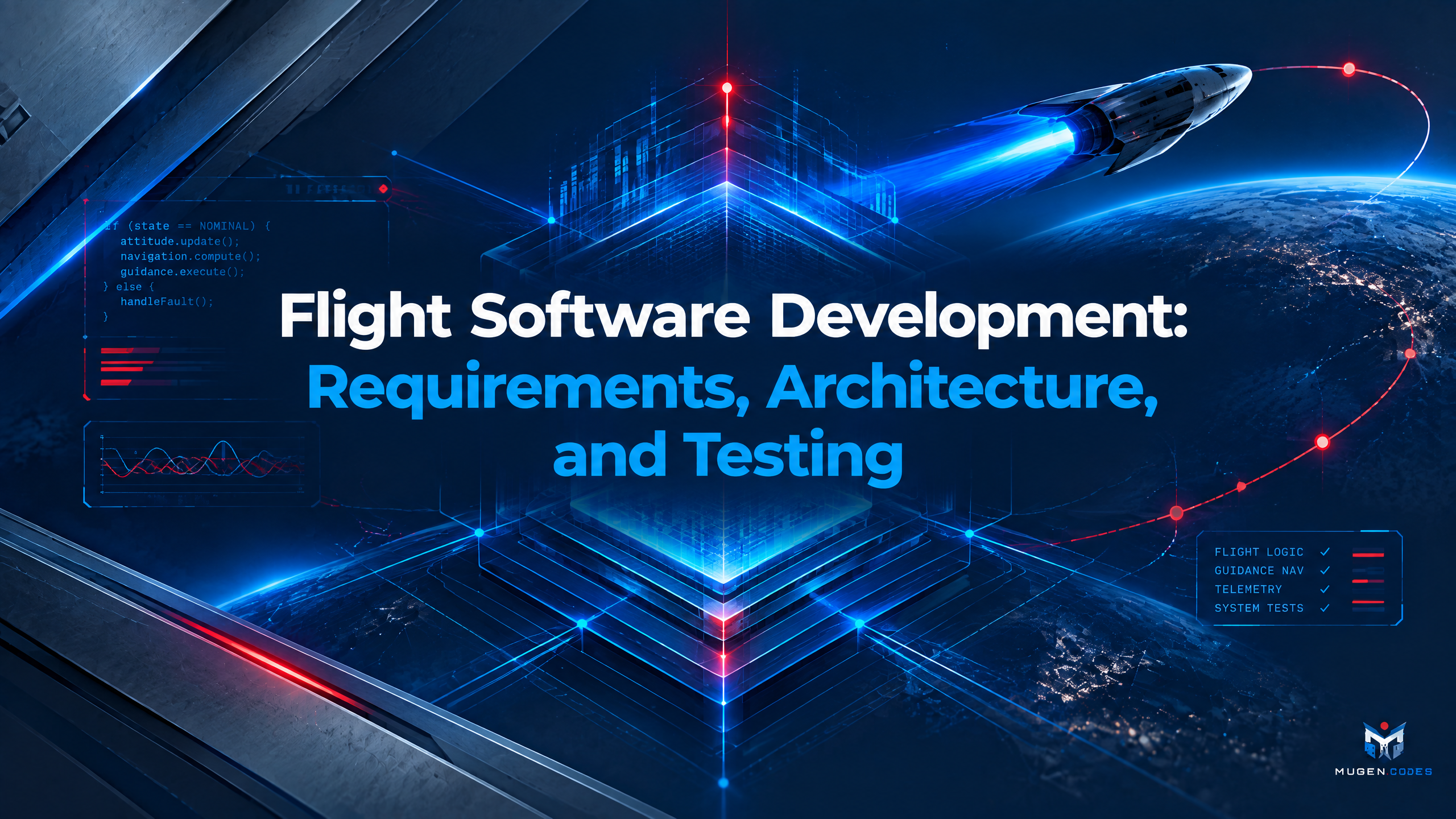
Explore flight software development from requirements and architecture to testing. Learn how reliable, mission-critical flight systems are designed, verified, and deployed.
TL;DR
- Flight software requires reliability, determinism, safety, and mission-specific engineering.
- Strong software starts with clear, testable requirements.
- Modular architecture improves reliability, testing, and maintainability.
- Testing spans unit, integration, simulation, hardware-in-the-loop, and system testing.
- The right engineering partner combines software, systems, and testing expertise.
Software has become central to how modern aircraft, spacecraft, unmanned systems, and other aerospace platforms operate. From processing sensor data to managing communications and executing mission functions, software often sits at the heart of systems where reliability and predictable behaviour are essential.
This is what makes flight software development different from building a typical software application. Developers must work within hardware constraints, strict timing requirements, safety considerations, complex interfaces, and mission-specific requirements. A small software failure can have consequences far beyond a conventional application error.
For engineering teams working on these systems, the development process needs to be deliberate from the beginning. Mugen.Codes approaches complex software engineering with this principle in mind, helping organisations turn demanding technical requirements into reliable and maintainable software systems.
Table of Contents
What Is Flight Software?
Flight software is the software that operates onboard an aircraft, spacecraft, UAV, or other flight platform. It communicates with onboard hardware and performs the computational tasks required to operate the vehicle and support its mission.
Depending on the platform, flight software may run on embedded processors and interact directly with sensors, actuators, communication systems, navigation equipment, payloads, and other onboard components.
Unlike software designed primarily for user interaction, flight software is usually built around the behaviour and requirements of the physical system. Its job is to make hardware and mission capabilities work together in a predictable way.
What Does Flight Software Control?
The responsibilities of flight software depend on the platform and mission, but common functions include:
- Guidance, navigation, and control: Processing information and supporting the vehicle’s movement and orientation.
- Sensor management: Collecting, processing, and monitoring data from onboard sensors.
- Actuator control: Sending commands to physical components that influence vehicle operation.
- Telemetry and communications: Managing the collection and transmission of operational data.
- Power management: Monitoring and controlling power-related functions where required.
- Payload operations: Managing mission-specific instruments and payload systems.
- Mission sequencing: Executing predefined commands, procedures, or mission activities.
- Fault detection and recovery: Identifying abnormal conditions and initiating appropriate responses.
- Data handling: Processing, storing, and transferring information generated during operation.
These functions can operate simultaneously and may depend on one another. That means flight software must be designed with a clear understanding of both individual functions and the wider system in which they operate.
Requirements for Flight Software Development
Clear requirements establish what the software must do and the conditions it must operate under. They should be specific, measurable, and testable.
Defining Flight Software Requirements
Flight software requirements should describe expected behaviour in a way that is specific, measurable, and testable.
Depending on the system, requirements may address:
- Functional requirements: What the software must do.
- Performance requirements: How quickly or efficiently it must perform specific functions.
- Interface requirements: How the software communicates with hardware and other software.
- Safety requirements: How the system should behave when hazardous or abnormal conditions occur.
- Security requirements: How software, data, interfaces, and communications should be protected.
- Reliability requirements: The expected availability and behaviour of the software during operation.
- Environmental requirements: Conditions that may affect software operation or the hardware on which it runs.
- Maintainability requirements: How the software should be diagnosed, updated, and supported over its lifecycle.
The goal is not simply to create a long requirements document. Each requirement should provide useful direction for design and implementation while giving engineers a clear basis for later verification.
Real-Time and Deterministic Behaviour
Many flight systems depend on software responding within defined time constraints. In these environments, it is not enough for an operation to eventually produce the correct result. It may need to produce that result within a specific timeframe.
This introduces requirements around:
- Execution timing
- Response latency
- Task scheduling
- Interrupt handling
- Processor utilisation
- Memory usage
- Communication timing
Deterministic behaviour is particularly important when software interacts with physical systems. Engineers need confidence that critical functions will behave predictably under expected operating conditions.
Hardware and Software Interface Requirements
Flight software does not operate in isolation. It needs to communicate with the hardware that makes up the platform.
Requirements therefore need to account for interfaces involving components such as:
- Processors
- Sensors
- Actuators
- Memory
- Communication buses
- Embedded controllers
- Navigation systems
- Mission payloads
Clearly defined interfaces help prevent misunderstandings between hardware and software teams. They also make it easier to identify what data is exchanged, how commands are structured, what timing is expected, and how errors should be handled.
Reliability, Safety, and Fault-Tolerance Requirements
Flight systems need to account for the possibility that something will not behave as expected. Software requirements should therefore define how the system responds to faults rather than assuming that every component will always function correctly.
Depending on the mission, this can include requirements for:
- Fault detection
- Fault isolation
- Fault recovery
- Redundant components
- Watchdog mechanisms
- Safe-state transitions
- Graceful degradation
- Recovery from invalid or unexpected inputs
The objective is to ensure that an individual fault does not automatically become a system-level failure. The software should have defined responses for the failure conditions that matter to the mission.
Requirements Traceability
Requirements traceability creates a clear connection between what the system is expected to achieve and how that expectation is implemented and verified.
A typical relationship can be represented as:
Requirement → Design → Implementation → Test → Verification
This makes it easier for engineering teams to answer important questions throughout development:
- Has every critical requirement been implemented?
- Where is a particular requirement addressed in the software?
- Which test demonstrates that the requirement has been satisfied?
- What changes could affect an existing requirement?
Traceability also provides a structured way to manage changes. When a requirement evolves, teams can identify the software components and verification activities that may need to change with it.
For flight software development, this level of visibility is not administrative overhead. It is part of building confidence that the software does what the system requires it to do.
Designing the Architecture for Flight Software
A strong flight software architecture provides a clear structure for how software components interact with hardware and with one another. It should support reliability, predictable performance, testability, and long-term maintenance.
What Makes a Strong Flight Software Architecture?
A well-designed architecture should be:
- Modular: Components have clear, focused responsibilities.
- Reliable: Failures can be contained and managed.
- Testable: Components can be tested independently.
- Maintainable: Changes can be made without disrupting the entire system.
- Predictable: Critical functions behave consistently under defined conditions.
Common Layers of Flight Software Architecture
Flight software is often organised into layers that separate hardware concerns from higher-level mission functions.
Hardware Abstraction Layer
The Hardware Abstraction Layer, or HAL, provides a consistent interface between application software and physical hardware. This reduces hardware-specific dependencies and can make software easier to test and maintain.
Real-Time Operating System
An RTOS manages critical resources and activities such as:
- Task scheduling
- Timing
- Memory
- Inter-process communication
- Resource allocation
It helps ensure software tasks execute within their required time constraints.
Drivers and Middleware
Drivers allow software to communicate with specific hardware components, while middleware provides reusable services and communication mechanisms between software components.
Application Layer
The application layer contains mission-specific functionality, such as:
- Guidance and navigation
- Flight control
- Telemetry
- Payload management
- Mission logic
Modular and Layered Design
Separating responsibilities into well-defined modules reduces unnecessary dependencies. It also makes individual components easier to develop, test, replace, and maintain.
Interface Design
Clear interfaces define how components exchange data and commands. Good interface design reduces integration issues and creates predictable interactions between software, hardware, and external systems.
The Flight Software Development Lifecycle
Flight software development follows a structured process that connects system requirements to working and verified software.
From Requirements to Deployment
A typical lifecycle includes:
Requirements → Architecture → Design → Implementation → Integration → Verification → Validation → Deployment
Each stage builds on the previous one, creating a controlled path from system objectives to operational software.
Development and Configuration Management
Disciplined configuration management helps teams control:
- Source code
- Software versions
- Requirements
- Builds
- Releases
- Documentation
- Changes
This is particularly important when multiple teams are working on complex systems over long development cycles.
Coding Standards and Engineering Discipline
Flight software benefits from consistent engineering practices, including:
- Code reviews
- Coding standards
- Static analysis
- Defensive programming
- Automated builds
- Clear documentation
These practices help reduce defects and make the codebase easier to understand and maintain.
Continuous Verification
Verification should happen throughout development rather than being left until the end. Testing requirements and software components continuously helps teams identify defects earlier, reduce integration risks, and maintain confidence as the system evolves.
Testing and Verification in Flight Software Development
Testing should be planned alongside requirements and architecture.
A useful verification strategy answers four questions:
- What must be demonstrated?
- What evidence will demonstrate it?
- At what integration level should it be demonstrated?
- What test environment is representative enough to make the evidence meaningful?
Unit Testing
Unit testing examines individual functions or components.
It is useful for identifying defects close to their source and can provide fast feedback during development.
Integration Testing
Integration testing evaluates interactions between components.
It is particularly important for:
- Interface assumptions
- Data conversion
- Timing
- State transitions
- Communication
- Error handling
Software-in-the-Loop
Software-in-the-loop testing executes software with simulated hardware or system behaviour.
It can be useful for exercising algorithms and mission logic before physical integration.
Its limitation is equally important: simulation cannot automatically demonstrate behaviour that depends on physical hardware.
Hardware-in-the-Loop
Hardware-in-the-loop introduces actual or representative hardware into the test environment.
It can expose issues involving:
- Real timing
- Hardware interfaces
- Sensor/actuator behaviour
- Communication paths
- Processor characteristics
- Integration assumptions
HIL does not replace other forms of verification. It answers different questions.
System-Level Testing
System testing evaluates the integrated system against representative operational scenarios.
This is where interactions between software, hardware, communications, mission logic, and operational procedures become especially important.
Fault Injection
Fault injection deliberately introduces defined abnormal conditions to evaluate system responses.
Depending on the system, examples can include:
- Invalid sensor data
- Communication loss
- Hardware faults
- Timing anomalies
- Memory or resource exhaustion
- Unexpected command sequences
The objective is to determine whether the system responds as specified rather than simply confirming that the normal path works.
Regression Testing
Every significant change can introduce unintended effects.
A regression strategy reruns appropriate verification activities after changes so that previously demonstrated behaviour remains protected.
Verification Evidence Matters
A mature flight-software process does not stop at “the test passed.”
The evidence should make it possible to understand:
- What requirement was tested
- What configuration was tested
- What environment was used
- What inputs were applied
- What result was expected
- What result occurred
- Whether the test passed or failed
- What deviations or anomalies occurred
The precise evidence package depends on the governing development and assurance process.
This is one reason requirements: traceability, configuration management, test management, and software development cannot be treated as independent activities.
Flight Software vs. Ground Software
Flight and ground software can be part of the same mission system, but their operating constraints are different.
| Characteristic | Flight software | Ground software |
| Execution environment | Onboard vehicle hardware | Ground infrastructure |
| Computing resources | Often constrained | Usually more flexible |
| Timing | May have hard or tightly bounded timing requirements | Depends on application |
| Hardware interaction | Direct or near-direct | Usually indirect |
| Communications | May be bandwidth- and latency-constrained | Generally more available |
| Failure consequences | Can directly affect vehicle behaviour | Often operational rather than immediate physical effects |
| Updates | May require controlled deployment and qualification | Usually easier to modify and redeploy |
The distinction is important because a design optimized for a ground application may not be suitable for onboard execution.
Challenges in Flight Software Development
System Complexity
Flight software may interact with numerous hardware components, subsystems, and external interfaces. Managing these dependencies requires careful architecture and integration.
Hardware Constraints
Limited processing power, memory, storage, and energy can influence software design and implementation.
Performance vs. Reliability
Optimising performance must be balanced against predictability, stability, and reliability. Faster software is not necessarily better if it becomes difficult to verify or maintain.
Hardware-Software Integration
Hardware and software often have to work together closely, making interface mismatches and integration issues important development risks.
Long-Term Maintainability
Flight systems can have long operational lifecycles. Clear documentation, modular code, configuration management, and maintainable architecture help support future updates.
Security and Resilience
Flight software must account for security risks while maintaining reliable operation. Secure interfaces, controlled access, robust architecture, and appropriate failure handling all contribute to system resilience.
Best Practices for Flight Software Development
A disciplined engineering approach can reduce development and operational risks.
- Design for testability: Build components that can be isolated and verified.
- Use modular architecture: Keep responsibilities separated and interfaces clear.
- Automate testing: Automate repeatable tests to improve consistency and coverage.
- Maintain requirements traceability: Connect requirements to implementation and verification.
- Test failure scenarios: Validate how the system behaves under abnormal conditions.
- Integrate software and systems engineering early: Resolve hardware, software, and interface issues before they become costly.
- Build for maintainability: Prioritise clear code, documentation, configuration control, and manageable dependencies.
For Mugen.Codes, these practices reflect a broader engineering principle: reliable software is built through disciplined processes, continuous validation, and careful attention to the environment in which the system must operate.
How to Choose a Flight Software Development Partner
Choosing the right development partner is about more than finding developers with the right technical skills. The team must understand the engineering constraints, risks, and verification demands of mission-critical software.
Capabilities to Look For
Look for a partner with experience in:
- Embedded and systems software
- Complex software architecture
- Hardware-software integration
- Testing and verification
- Secure software development
- Requirements and configuration management
- Long-term software maintenance
Questions to Ask Before Hiring a Development Team
Before selecting a partner, ask:
- How do you translate system requirements into software requirements?
- How do you approach hardware-software integration?
- What testing and verification processes do you use?
- How do you handle faults and unexpected system behaviour?
- How do you maintain software quality throughout development?
How Mugen.Codes Supports Flight Software Development
Engineering Around Real-World Constraints
Mugen.Codes approaches software development with the understanding that complex systems have real technical constraints. Architecture, performance, security, integration, and maintainability are considered alongside functionality.
Supporting the Development Lifecycle
From requirements and architecture through development, integration, and testing, Mugen.Codes can support teams building complex software systems.
Building for Reliability, Testability, and Maintainability
Mugen.Codes focuses on engineering software that is structured, testable, maintainable, and designed around the needs of the system it supports.
Why the Engineering Partner Matters
The right partner brings more than coding capacity. They bring engineering discipline, technical problem-solving, and the ability to turn complex requirements into software that can be developed, tested, and maintained with confidence.
FAQs
Flight software development is the process of designing, building, integrating, and testing software that operates onboard aircraft, spacecraft, UAVs, and other flight platforms. It connects onboard hardware with the software functions needed to operate the vehicle and support its mission.
C, C++, and Ada are commonly used in flight software development because they provide control over system resources and support embedded and real-time environments. The appropriate language depends on the platform, hardware, safety requirements, and development environment.
Key requirements typically include functionality, performance, timing, reliability, safety, security, hardware compatibility, and maintainability. Requirements should also be specific and testable so engineers can verify that the software performs as expected.
Flight software can be tested at multiple levels, including unit testing, integration testing, software-in-the-loop testing, hardware-in-the-loop testing, system-level testing, fault injection, and regression testing. Using several testing methods helps identify problems at both component and system levels.
Look for a partner with strong software engineering, embedded systems, architecture, integration, testing, and security capabilities. It is also important to evaluate how the team manages requirements, development processes, documentation, configuration, and long-term software maintenance.
Final Thoughts on Flight Software Development
Reliable flight software starts with clear requirements, a thoughtful architecture, and rigorous testing. These elements work together to create software that can perform predictably within demanding operational environments.
For complex aerospace and mission-critical systems, disciplined engineering is essential. The right development partner can help turn challenging requirements into software that is reliable, testable, and maintainable.
Building software for a complex flight or mission-critical system? Explore Mugen.Codes to discover how its software engineering capabilities can support your next complex, mission-critical project.