
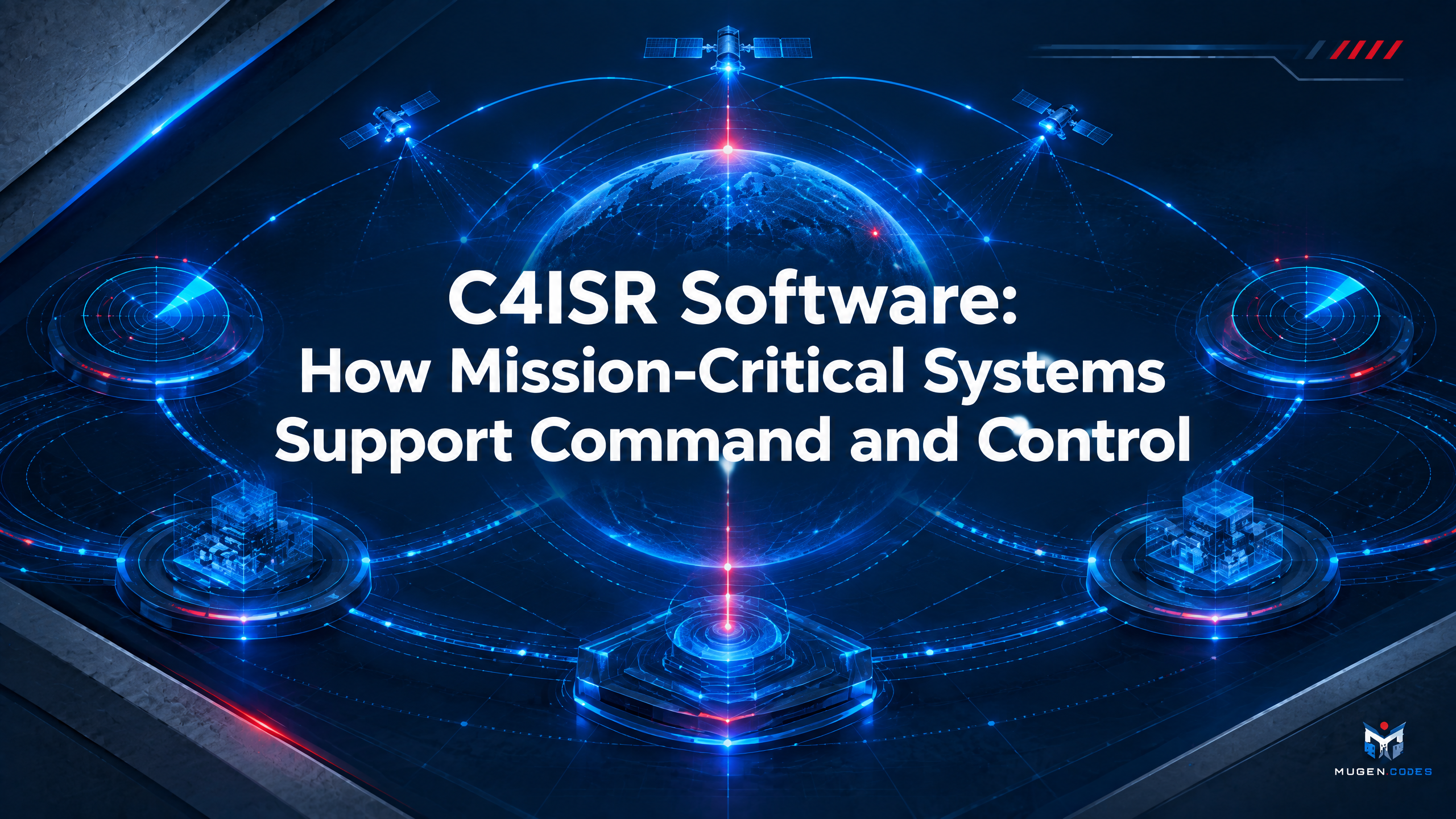
Explore how C4ISR software connects command, communications, intelligence, surveillance, and reconnaissance to support secure, reliable mission-critical operations.
TL;DR
- C4ISR software connects critical command, control, communications, and intelligence capabilities.
- Mission-critical systems require security, reliability, interoperability, and low latency.
- Data integration helps create a unified operational picture.
- C4ISR software must support complex and evolving operational requirements.
- Specialized software engineering is essential for reliable C4ISR systems.
C4ISR software connects information, communications, computing, and command-and-control capabilities to enable reliable operations across complex environments.
A well-engineered C4ISR environment must enable systems to exchange information reliably, protect data and communications, support a coherent operational picture, and adapt as operational requirements and technologies evolve.
U.S. government material describes C4ISR more broadly as a combination of systems, procedures, and techniques used to collect and disseminate information, including command-and-control networks and systems supporting common operational or tactical pictures. This makes C4ISR an interconnected capability rather than a single software application or technology stack.
For software engineering teams, C4ISR presents many of the challenges associated with building complex, secure, and mission-critical systems. Mugen.Codes applies software engineering principles relevant to these environments, including systems integration, reliable architecture, security, performance, and lifecycle planning.
Understanding how these principles apply to C4ISR helps illustrate what it takes to develop software that can operate effectively across diverse systems, networks, data sources, and operational requirements.
Table of Contents
What Is C4ISR?
C4ISR stands for Command, Control, Communications, Computers, Intelligence, Surveillance, and Reconnaissance. It describes a connected set of capabilities used to collect information, communicate it across systems, understand what is happening, and support operational command.
Each element contributes a different function:
- Command: Establishes objectives and directs operations.
- Control: Helps coordinate activities and resources.
- Communications: Enables information to move between people and systems.
- Computers: Provide the processing and computing infrastructure needed to manage information.
- Intelligence: Turns collected information into insights that can support operations.
- Surveillance: Monitors areas, systems, or activities of interest.
- Reconnaissance: Collects information about an environment or situation.
The value of C4ISR comes from how these capabilities work together. Instead of treating each system as a separate source of information, an integrated architecture can allow relevant data to move between systems and reach the people who need it.
What Does C4ISR Software Do?
C4ISR software refers to the applications, platforms, middleware, interfaces, and supporting software components that enable these capabilities to communicate and operate together.
C4ISR software can occupy several layers of a larger architecture.
It may include:
- operational applications and user interfaces;
- command-and-control applications;
- data-processing services;
- integration middleware;
- APIs and system gateways;
- message-processing components;
- databases and data services;
- communications software;
- monitoring and health-management services;
- analytics and decision-support tools;
- security and identity components.
The exact architecture depends on the operational requirements. There is no single C4ISR software architecture that is appropriate for every environment.
How C4ISR Software Supports Command and Control
Integrating Information From Multiple Sources
A C4ISR environment can contain information from sensors, databases, communications systems, applications, platforms, and external sources.
The integration challenge is not simply connecting those sources.
A useful integration architecture needs to address questions such as:
- What does each data field mean?
- Which source is authoritative for a particular type of information?
- How is data freshness represented?
- How are timestamps synchronized?
- What happens when a source becomes unavailable?
- How are incompatible formats transformed?
- How are duplicate or conflicting observations handled?
- Which users and systems are permitted to receive the information?
These questions turn integration from a simple connectivity exercise into a systems-engineering problem.
Government experience with C4ISR programs illustrates why this distinction matters. GAO has documented cases where systems intended to share common operational information encountered interoperability and information-sharing problems despite substantial investment in the underlying systems.
Processing Real-Time and Near-Real-Time Information
“Real-time” should not be treated as a universal performance specification.
One C4ISR function may require very low end-to-end latency, while another may operate satisfactorily with updates delivered at longer intervals.
Engineering teams should therefore define measurable requirements such as:
- maximum acceptable end-to-end latency;
- processing latency;
- message throughput;
- update frequency;
- latency variation or jitter;
- behavior during network congestion;
- recovery time following service disruption.
A useful performance measurement might trace an event from its original source through ingestion, processing, transmission, and presentation. This exposes delays that would remain invisible if developers measured only application response time.
Building a Common Operational Picture
A common operational picture, or COP, aims to provide users with a coherent representation of relevant operational information.
The difficult part is not creating a dashboard. It is establishing confidence that the information being displayed is:
- relevant;
- appropriately current;
- correctly attributed;
- understandable in context;
- available to authorized users;
- presented without introducing misleading interpretations.
Historical U.S. government reporting describes C4ISR architectures as connecting assets, communications, information, and the means of displaying that information as a common operating picture.
The software therefore has to solve both a data problem and a human-information problem.
More information is not automatically better. Poorly prioritized information can increase cognitive load and make important changes harder to identify.
Securing Communications and Information
Security needs to be designed into the architecture rather than bolted on after the core application is complete.
Relevant controls can include:
- identity and access management;
- authentication and authorization;
- encryption;
- secure communications;
- input validation;
- secure API design;
- secrets management;
- dependency management;
- logging and monitoring;
- vulnerability management;
- secure build and deployment processes.
NIST’s SSDF is specifically intended to integrate secure-development practices into software development lifecycles rather than treating security as an isolated activity.
For a C4ISR environment, security analysis also needs to consider the relationships between systems. An interface can become an attack surface, and a trusted component can become a dependency whose compromise affects other parts of the architecture.
Supporting Human Decision-Making
C4ISR software can provide users with:
- alerts;
- operational displays;
- historical information;
- current-status information;
- analytical outputs;
- event detection;
- data correlation;
- planning and coordination tools.
These capabilities should support human decision-making rather than obscure the provenance or limitations of the underlying information.
Where analytics or AI are introduced, engineering teams should consider:
- source-data quality;
- model performance;
- false positives and false negatives;
- uncertainty;
- explainability requirements;
- monitoring for changing data conditions;
- human review;
- consequences of incorrect outputs.
The appropriate controls depend on the operational role of the system.
Why C4ISR Software Is Mission-Critical
In a mission-critical environment, software failure can have consequences beyond a disrupted user experience. Delayed information, unavailable services, inaccurate data, or failed system connections can affect how quickly people understand and respond to changing situations.
This makes several engineering characteristics particularly important:
- Reliability: Systems need to perform consistently under demanding conditions.
- Availability: Critical capabilities should remain accessible when required.
- Security: Systems and data must be protected against unauthorized access and compromise.
- Interoperability: Different systems need to exchange and interpret information effectively.
- Performance: Time-sensitive information may need to be processed and delivered with minimal delay.
- Resilience: Systems should be designed to handle failures and recover without unnecessary disruption.
These requirements influence decisions throughout the software lifecycle, from initial architecture and requirements engineering to integration, testing, deployment, and maintenance.
Core Engineering Requirements for C4ISR Software
Security by Design
Security should be built into C4ISR software from the beginning, particularly because these systems may connect multiple networks, applications, devices, and data sources.
Key practices include:
- Threat modeling during planning and architecture.
- Strong authentication and authorization.
- Data protection in transit and at rest.
- Secure development and testing.
- Continuous assessment of interfaces and dependencies.
Reliability and Availability
C4ISR software should be designed to remain operational during component failures or disruptions. Redundancy, fault tolerance, health monitoring, automated recovery, and graceful degradation can help maintain availability.
Interoperability
C4ISR environments often combine platforms, vendors, applications, sensors, and legacy systems. Well-defined interfaces, data models, protocols, and integration mechanisms allow these systems to exchange and correctly interpret information.
Scalability
Operational requirements can change over time, requiring systems to support additional users, data sources, sensors, platforms, or workloads. Scalable architectures allow capabilities to expand without requiring a complete redesign.
Low-Latency Data Processing
Time-sensitive operations require information to be processed and delivered quickly and predictably. Developers need to consider:
- Data pipelines
- Network conditions
- Processing workloads
- Communication protocols
- Data prioritization
The goal is to meet required response times without compromising security, accuracy, or reliability.
Maintainability and Upgradeability
C4ISR systems can operate for many years while technologies and requirements evolve. Modular architectures, clear interfaces, automated testing, documentation, and controlled deployments make systems easier to maintain and upgrade without unnecessarily disrupting existing functionality.
Testing C4ISR Software
- Functional testing: Verifies that software meets defined requirements.
- Integration testing: Tests interactions between applications, interfaces, databases, networks, and external systems.
- Performance testing: Measures latency, throughput, resource usage, and behavior under load.
- Resilience testing: Evaluates system behavior during failures, network disruptions, and recovery.
- Security testing: Assesses authentication, authorization, vulnerabilities, configurations, and security controls.
- Data-integrity testing: Ensures information remains accurate and complete across system interfaces and transformations.
- Verification & validation: Confirms both that the system meets its specifications (verification) and fulfills its intended operational purpose (validation).
Challenges in Developing C4ISR Software
Integrating Legacy Systems
C4ISR environments often include older systems that remain operational and cannot simply be replaced. New software may need to work alongside these systems through carefully designed interfaces, data mapping, and compatibility testing.
Managing Complex System Integration
Multiple platforms, applications, networks, and sensors may need to exchange information. Clear interfaces, dependency management, and integration testing help ensure that changes in one component do not create problems elsewhere.
Addressing Cybersecurity Threats
Connected systems create multiple points that need protection. Security should be incorporated throughout development through access controls, secure interfaces, threat assessment, monitoring, and security testing.
Testing Mission-Critical Software
Testing needs to cover more than basic functionality. Teams should evaluate:
- System and integration behaviour.
- Performance and latency.
- Security controls.
- Failure and recovery scenarios.
- Data and communication reliability.
Balancing Performance, Security, and Reliability
Security, speed, reliability, and resilience can introduce competing technical requirements. These trade-offs need to be considered during architecture and development based on the system’s operational needs.
The C4ISR Software Development Lifecycle
Requirements Engineering
Teams first define what the system needs to achieve, including functional, security, performance, availability, and interoperability requirements.
System and Software Architecture
Architecture establishes how applications, data, interfaces, infrastructure, and communication mechanisms work together. It should also allow the system to evolve as requirements change.
Development and Integration
Software components are developed and progressively integrated with surrounding systems. Incremental integration and automated testing can help identify issues earlier.
Verification and Validation
Verification confirms that the software meets defined requirements, while validation assesses whether it meets its intended operational purpose. Both provide evidence that the system performs as expected.
Deployment and Lifecycle Support
C4ISR software may operate for many years. Ongoing support can include monitoring, maintenance, security updates, upgrades, performance improvements, and modernization.
Selecting a C4ISR Software Engineering Partner
What to Look For
Look for a partner with experience in:
- Mission-critical software engineering.
- Secure development.
- Complex systems integration.
- Legacy-system integration.
- Interoperability and distributed architectures.
- Testing and verification.
- Long-term software lifecycle support.
A strong partner should also be able to explain technical trade-offs clearly and connect engineering decisions to operational requirements.
Questions to Ask a Development Partner
- How do you translate operational requirements into software requirements?
- How is security handled throughout development?
- How do you integrate legacy and third-party systems?
- What testing and validation processes do you use?
- How do you design for interoperability and future changes?
- What support do you provide after deployment?
How Mugen.Codes Supports Mission-Critical Software Engineering
C4ISR environments require software engineering that accounts for complex systems, demanding operational requirements, and long software lifecycles.
Mugen.Codes approaches these challenges through engineering practices focused on building secure, reliable, and adaptable software systems.
Engineering for Complex Operational Environments
Mugen.Codes works on software where reliability, performance, and system behaviour are important to the wider mission. This requires understanding the operational environment, technical constraints, and relationships between connected systems before development begins.
Secure and Reliable Software Architecture
Security and reliability need to be considered at the architectural level. Mugen.Codes can apply engineering practices that address system resilience, controlled access, dependable operation, and maintainability throughout the software lifecycle.
Systems Integration and Interoperability
Complex environments often require different systems to exchange information despite differences in technology or design. Mugen.Codes focuses on structured interfaces and integration approaches that help connected systems communicate effectively.
Defense, Space, and Other Mission-Critical Applications
The engineering principles behind C4ISR software also apply to other environments where software reliability and system performance are critical. Mugen.Codes’ work across defense, space, and other mission-critical applications reflects the need for disciplined engineering in these settings.
Requirements-Driven Software Engineering
Effective mission-critical software starts with clearly understood requirements. Mugen.Codes approaches development by connecting software decisions to defined technical and operational needs, helping ensure that architecture and implementation remain aligned with the intended outcome.
FAQs
C4ISR software consists of the applications, interfaces, middleware, and supporting components that connect Command, Control, Communications, Computers, Intelligence, Surveillance, and Reconnaissance capabilities. It helps systems exchange, process, and present information across complex operational environments.
It connects information from multiple sources, processes and distributes data, supports situational awareness, enables secure communication, and provides tools that can assist users with operational decision-making.
Key requirements can include security, reliability, availability, interoperability, scalability, performance, resilience, and maintainability. The specific requirements depend on the operational role and environment of the system.
C4ISR environments can contain systems from different vendors, technologies, and generations. Interoperability allows these systems to exchange and correctly interpret information, reducing silos and supporting a more connected operational environment.
Common challenges include integrating legacy systems, managing complex dependencies, addressing cybersecurity risks, testing under demanding conditions, and balancing performance with security and reliability.
Final Thoughts On C4ISR Software
C4ISR software provides the connective foundation for many command and control capabilities. Its effectiveness depends on more than functionality. Security, interoperability, reliability, performance, and long-term maintainability all need to be considered as part of the engineering process.
For organizations developing complex software in defense, space, or other mission-critical environments, the right engineering approach can help turn demanding operational requirements into dependable software systems.
Explore Mugen.Codes to discover how its software engineering capabilities can support complex, secure, and mission-critical systems.