
Discover how satellite software development supports mission-critical space systems, from requirements and architecture to testing, security, integration, and deployment.
TL;DR
- Satellite software enables critical spacecraft and mission operations.
- Space software must be reliable, secure, and fault-tolerant.
- Mission-critical systems require rigorous engineering and testing.
- Software must account for resource and environmental constraints.
- Modern satellites increasingly depend on autonomous and software-driven capabilities.
Satellite software is responsible for much more than sending commands and collecting data.
It can coordinate spacecraft operations, communicate with ground systems, manage payloads, monitor vehicle health, respond to faults, and support increasingly autonomous mission functions.
What makes satellite software different from conventional application development is the operating environment.
Once a spacecraft is launched, engineers cannot normally access the hardware directly to replace a failed component, attach a debugger, or install an untested build. Computing, memory, power, communications bandwidth, and physical access can also be constrained.
As a result, satellite software development is fundamentally a systems-engineering and assurance problem, not simply a programming task.
For engineering teams working on these challenges, the focus extends beyond writing functional code. Mugen.Codes approaches mission-critical software engineering with an emphasis on reliable architecture, secure systems, rigorous testing, and integration, principles that are essential when building software for demanding space environments.
Table of Contents
What Is Satellite Software Development?
Satellite software development is the process of designing, building, testing, and maintaining software that supports the operation of spacecraft and their associated ground systems.
It covers everything from low-level software that interacts directly with satellite hardware to applications used by teams monitoring and controlling missions from Earth.
The development process must account for the specific operating conditions of space. Software needs to perform predictably, manage limited resources efficiently, respond to faults, and communicate reliably across systems that may be separated by significant distances.
Types of Satellite Software
Satellite missions typically rely on several interconnected software components, including:
- Flight software: Runs onboard the spacecraft and manages functions such as command execution, telemetry, power, and fault handling.
- Ground control software: Enables operators to communicate with and monitor the satellite from Earth.
- Payload software: Controls instruments and processes data collected by the satellite’s payload.
- Mission operations software: Supports planning, scheduling, monitoring, and coordination of mission activities.
- Data processing software: Converts, organises, and analyses data received from spacecraft systems and payloads.
- Simulation software: Replicates spacecraft behaviour and operating conditions for development, testing, and mission preparation.
Why Satellite Software Is Mission-Critical
A spacecraft’s software can participate in functions ranging from routine command execution to fault detection and recovery.
A software defect may therefore affect an individual feature, a subsystem, or, depending on the failure mode, the spacecraft’s ability to continue its mission.
That makes predictability and verifiable behaviour more important than simply producing a feature-rich application.
Engineering teams typically have to consider:
- Functional and performance requirements
- Timing constraints
- Hardware interfaces
- CPU, memory, storage, and power budgets
- Communications limitations
- Fault detection and recovery
- Cybersecurity
- Configuration control
- Verification and validation
- Long-term maintainability
The appropriate engineering controls depend on the spacecraft, mission objectives, hardware architecture, and risk profile. There is no single satellite-software architecture that applies to every mission.
How Mission-Critical Space Systems Are Built
Satellite software is normally developed as part of a broader systems-engineering process.
Software requirements cannot be separated completely from spacecraft hardware, communications, payloads, operations, and mission constraints.
Define Mission Objectives and Requirements
Development begins with the mission’s objectives and constraints.
These are translated into requirements describing what the system must do and the conditions under which it must perform.
Requirements may address:
- Functional behaviour
- Timing
- Performance
- Interfaces
- Resource consumption
- Reliability
- Fault response
- Communications
- Security
- Operational constraints
Good requirements are testable. A requirement such as “the system should be reliable” is not sufficient by itself because it does not establish measurable acceptance criteria.
A stronger requirement defines the expected behaviour and the conditions under which that behaviour must be demonstrated.
Establish the System Architecture
Architecture defines how spacecraft components interact.
Engineers establish boundaries between:
- Hardware
- Flight software
- Payloads
- Communications
- Ground systems
- Operators
- External mission systems
The architecture also defines interfaces and data flows.
This matters because many spacecraft failures are not caused by an isolated software function. Problems can emerge at interfaces for example, when assumptions about timing, data formats, states, or fault conditions differ between components.
Design Around Spacecraft Constraints
Software has to operate within the capabilities of the target hardware.
Typical constraints can include:
- Processor capacity
- Memory
- Non-volatile storage
- Power consumption
- Communication bandwidth
- Timing
- Thermal limits
- Hardware availability
The correct response is not always simply to “optimize the code.” Engineers first need to understand which resource is actually limiting the system and whether the architecture or workload should change.
Design for Faults
A spacecraft should not be designed on the assumption that every component will behave correctly throughout the mission.
Fault-management strategies can include:
- Detecting abnormal behaviour
- Isolating the affected function where possible
- Recovering automatically when a safe recovery is known
- Reducing functionality when necessary
- Entering a predefined safe state when continued operation is unsafe
The appropriate strategy depends on the mission and hardware.
For example, redundancy can improve resilience, but redundant components introduce additional design and verification complexity. Similarly, automatic recovery can reduce the need for ground intervention but must itself be carefully bounded and tested.
The engineering objective is therefore not simply “prevent failure.” It is to define how the system behaves when failure occurs.
Develop and Integrate the Software
Once requirements and architecture are established, software components are implemented and integrated.
Disciplined development typically includes:
- Version control
- Code review
- Automated builds
- Static analysis
- Unit tests
- Interface testing
- Configuration management
- Defect tracking
- Documentation
Integration should occur progressively rather than waiting until the end of development. Early integration exposes interface problems while they are still relatively inexpensive to diagnose.
Verify and Validate the System
Verification and validation answer related but different questions.
Verification: Did the implementation satisfy the specified requirements?
Validation: Does the resulting system behave as intended for its operational purpose?
Both are important.
A function can pass a narrow software test and still fail to perform correctly when integrated with hardware or operated within a realistic mission scenario.
Security
Security must be considered throughout the system lifecycle. Satellite systems require protection for communications, command channels, ground infrastructure, software components, and sensitive mission data.
Security measures can include authentication, encryption, access controls, secure development practices, monitoring, and vulnerability testing.
Deployment and Operations
Before deployment, software undergoes extensive validation against mission requirements and expected operating conditions. After launch, teams monitor system behaviour, analyse telemetry, manage configurations, and may deliver controlled software updates when the mission architecture permits them.
Satellite Software Architecture
The architecture of a satellite software system depends heavily on the mission and spacecraft platform, but several recurring design concerns appear across missions.
Flight Software and Hardware Interfaces
Flight software frequently sits between mission-level logic and physical spacecraft hardware.
This makes interface design critical.
Engineers need to define assumptions about:
- Data representation
- Timing
- State transitions
- Hardware status
- Error conditions
- Command semantics
- Resource ownership
Ambiguous interfaces create integration risk because different components can behave correctly according to different assumptions.
Real-Time Behaviour
Some spacecraft functions have timing requirements that require deterministic or bounded responses.
Real-time engineering therefore involves more than selecting a programming language. It can involve:
- Task scheduling
- Interrupt handling
- Priority management
- Timing analysis
- Resource allocation
- Worst-case execution considerations
- Synchronization
Not every satellite function necessarily has the same timing requirements. Engineers should classify functions according to their actual operational constraints.
Modular Design
Modularity can make a complex system easier to test and maintain by separating functions behind defined interfaces.
However, modularity is not automatically beneficial. Excessive abstraction can consume scarce resources or make timing and failure behaviour harder to reason about.
The useful question is therefore not “Is the architecture modular?” but:
Does the chosen decomposition make the system easier to understand, verify, operate, and change without introducing unacceptable cost or risk?
The Satellite Software Development Lifecycle
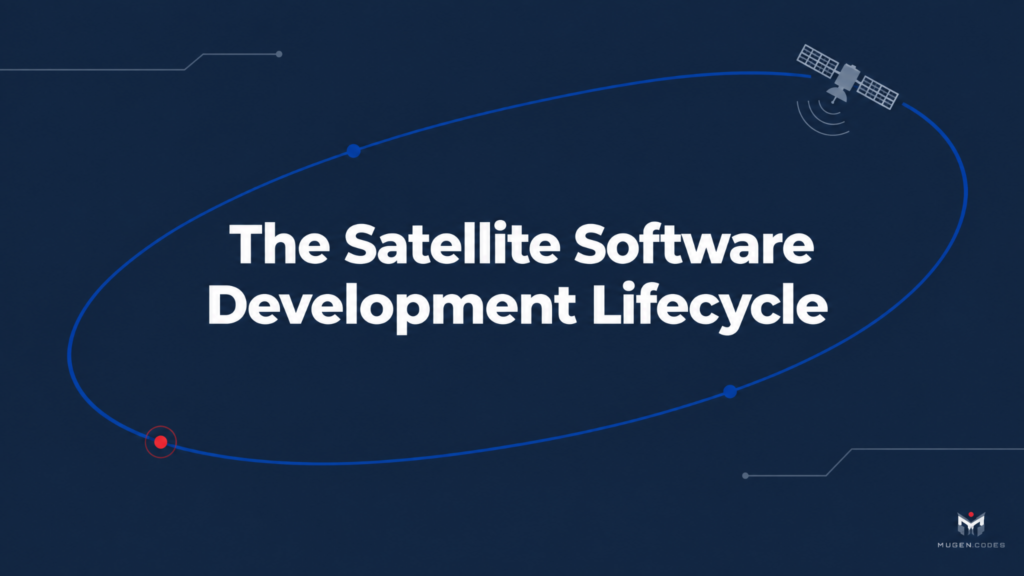
Developing software for a satellite follows a structured lifecycle designed to reduce risk and maintain traceability from the initial requirements through to mission operations. Each stage builds on the previous one, with testing and verification integrated throughout rather than left until the end.
Requirements
The process starts by defining what the software must accomplish and the conditions under which it must operate. Requirements establish functional behaviour, performance expectations, interfaces, resource limits, reliability targets, and security needs.
Design and Implementation
Engineers translate requirements into a software architecture and detailed technical design. Development then turns these designs into tested software components, supported by practices such as code review, version control, documentation, and configuration management.
Integration
Individual components are brought together and connected with spacecraft hardware, payloads, communication systems, and other software. Integration testing helps identify interface problems and unexpected interactions before system-level validation.
Verification and Validation
Verification determines whether the software meets its specified requirements, while validation evaluates whether the complete system performs as intended in realistic mission scenarios. Both provide evidence that the system is ready for its intended operational environment.
Deployment and Operations
After final validation, the software is prepared for deployment and mission commissioning. Operational teams then monitor system performance, review telemetry, manage configurations, and apply authorised updates where the mission architecture supports them.
How Satellite Software Is Tested
Space software requires layered testing because no single test environment reproduces every aspect of the operational system.
Unit Testing
Unit tests examine individual functions or components.
They help detect local defects early but cannot show that the complete spacecraft behaves correctly.
Integration Testing
Integration tests examine interactions between components.
They can expose problems involving:
- Interfaces
- Timing
- Data formats
- State management
- Error handling
- Resource contention
Simulation
Simulation makes it possible to exercise scenarios before using flight hardware.
It is particularly valuable for testing mission sequences and abnormal conditions that would be difficult or unsafe to reproduce on an operational spacecraft.
Hardware-in-the-Loop Testing
Hardware-in-the-loop testing connects software to representative hardware or hardware interfaces.
This can reveal issues that are invisible in purely software-based testing, including problems related to timing, physical interfaces, hardware states, and actual device behaviour.
Fault Injection
Fault injection deliberately introduces controlled failures.
Examples can include:
- Invalid sensor data
- Communication failures
- Component unavailability
- Resource exhaustion
- Unexpected state transitions
The objective is to determine whether the system detects and handles the condition according to its requirements.
Performance Testing
Performance testing measures behaviour under expected and demanding workloads.
Relevant metrics may include:
- CPU utilization
- Memory usage
- Execution time
- Response time
- Data throughput
- Scheduling behaviour
The measurements should be compared against defined requirements rather than described with vague terms such as “high performance.”
Security Considerations in Satellite Software Development
Security needs to be incorporated into the architecture and development process rather than treated as a final-stage check. Satellite systems can have multiple communication paths, software components, and ground interfaces that need appropriate protection.
Satellite Communications
Command and telemetry channels require controls that help prevent unauthorised access or manipulation. Depending on the mission, security measures can include encryption, authentication, integrity checks, and controlled command access.
Ground Systems
Ground infrastructure provides an important operational interface to the spacecraft. Access controls, network security, monitoring, logging, and secure configuration practices help protect systems used to manage missions and process satellite data.
Secure Development
Security considerations should extend across requirements, architecture, coding, testing, and maintenance. Practices such as threat modelling, secure coding, vulnerability assessment, dependency management, and security testing can help identify and address weaknesses throughout the software lifecycle.
Challenges in Satellite Software Development
Space software development combines demanding technical requirements with an environment where mistakes can be difficult or impossible to correct physically after deployment.
Reliability
Software may need to operate continuously for years with limited opportunities for intervention. Engineers therefore place significant emphasis on predictable behaviour, fault handling, redundancy, and extensive verification.
Resource Constraints
Onboard systems often operate with tightly controlled budgets for processing, memory, storage, and power. Software must make efficient use of these resources without compromising essential functions.
Communication Limitations
Satellites can experience limited bandwidth, communication windows, and signal delays. Software must therefore handle communication efficiently and continue performing appropriate functions when communication with ground systems is unavailable.
Systems Integration
Satellite missions bring together software, hardware, payloads, communication systems, and ground infrastructure. Differences between components and interfaces can introduce integration challenges that require careful architecture and testing.
Long-Term Maintenance
Mission software may need to remain operational for extended periods while the underlying hardware and operational requirements evolve. Effective configuration management, documentation, controlled updates, and maintainable architecture help support the system throughout its operational life.
Technologies and Engineering Practices for Space Software
Modern space software combines embedded engineering with increasingly sophisticated development and testing practices. The technologies selected must support predictable performance while making it possible to validate complex systems before they are deployed.
Embedded and Real-Time Technologies
Embedded software connects directly with spacecraft hardware and supports functions that may require precise timing. Real-time technologies help ensure critical operations are executed within defined time constraints while making efficient use of limited onboard resources.
Simulation and Digital Engineering
Simulation allows engineering teams to model spacecraft behaviour, test mission scenarios, and identify potential problems before deployment. Digital engineering can connect models, requirements, software, and system data to provide a more complete view of how different components interact.
Automated Development and Testing
Automation can improve consistency and reduce manual effort across the development lifecycle. Automated builds, regression testing, static analysis, and continuous integration can help teams identify defects earlier and maintain software quality as systems evolve.
AI and Autonomous Systems
AI can support capabilities such as onboard data processing, anomaly detection, mission planning, and autonomous decision-making. As these capabilities become more sophisticated, they also introduce additional requirements for validation, explainability, reliability, and controlled system behaviour.
Software Assurance, Traceability, and Standards
Software assurance provides evidence that development activities and resulting software satisfy defined requirements and quality objectives.
Requirements Traceability
Traceability connects requirements with design elements, implementation, tests, and verification evidence.
A useful traceability chain might look like:
Requirement → Design element → Implementation → Test → Verification result
This makes it easier to determine whether a requirement has actually been addressed and what may be affected by a change.
Configuration Management
Configuration management establishes which versions of software, hardware interfaces, documentation, and supporting artifacts constitute an approved baseline.
This is especially important when multiple teams are developing interconnected components.
Verification Evidence
Testing is only part of the evidence.
A mature assurance process may also maintain:
- Requirements records
- Design documentation
- Review records
- Test procedures
- Test results
- Defect records
- Configuration baselines
- Change approvals
The exact process should reflect the mission’s applicable requirements and assurance framework.
Standards require verification before citation
The publisher should identify and cite the standards that actually govern the target mission or development context rather than presenting a generic list of aerospace standards.
For Further Insights, read: Defense Software Development: Key Requirements for Secure, Mission-Critical Systems
How Mugen.Codes Supports Mission-Critical Software Engineering
Mugen.Codes focuses on software engineering for systems where reliability, security, and predictable performance are essential. Its approach aligns with the engineering demands of complex environments where software must integrate with other technologies and operate under demanding conditions.
Engineering for Complex Operational Environments
Mission-critical systems often involve complex requirements, specialised hardware, multiple interfaces, and demanding operational scenarios. Mugen.Codes applies structured engineering practices to help address these challenges from architecture through implementation.
Secure and Reliable Architecture
Reliable software starts with an architecture designed around the system’s operational requirements. Mugen.Codes focuses on robust architectures that consider resilience, security, maintainability, and system behaviour from the outset.
Systems Integration
Complex missions depend on different software and hardware components working together as a unified system. Mugen.Codes supports systems integration by addressing interfaces, dependencies, communication between components, and end-to-end system behaviour.
Testing and Verification
Testing provides evidence that software performs as intended under expected and challenging conditions. Mugen.Codes can apply structured testing and verification practices to evaluate functionality, integration, performance, and system reliability.
Space and Defense Applications
The engineering principles used in mission-critical software extend across demanding space and defense applications. These environments require software that can operate reliably within complex technical and operational constraints.
FAQs
Satellite software development is the process of designing, building, testing, and maintaining software that operates onboard spacecraft or supports their associated ground and mission systems.
Satellite missions can use flight software, embedded systems, payload software, ground control applications, mission operations software, data processing systems, and simulation tools.
The choice depends on the mission, hardware, operating environment, and software requirements. Languages commonly used in embedded and aerospace systems include C, C++, and Ada, while Python is often used for ground applications, automation, data processing, and testing.
Testing can include unit testing, integration testing, simulation, hardware-in-the-loop testing, fault injection, performance testing, and system-level verification. The goal is to evaluate both individual components and complete mission workflows.
Yes, some satellite systems can receive software updates after launch. The ability to update software depends on the spacecraft architecture, communications infrastructure, available memory, update mechanisms, and mission safety requirements.
Final Thoughts on Satellite Software Development
Satellite software is a critical part of modern space systems, connecting spacecraft hardware, payloads, communications, and ground operations.
Building reliable systems requires disciplined engineering across architecture, development, integration, security, testing, and verification.
As space missions become more software-driven and autonomous, engineering teams must continue to account for reliability, security, constrained resources, and complex system interactions. These considerations are what distinguish mission-critical software development from conventional application development.
Explore Mugen.Codes to learn more about its software engineering capabilities for complex, mission-critical environments across space, defense, and other demanding applications.