

Learn what BCI software is, how brain-computer interfaces process brain signals, their key components, and the engineering behind reliable BCI systems.
TL;DR
- BCI software processes brain activity and converts relevant signals into commands, data, or interactions with digital systems.
- A typical BCI system combines signal processing, feature extraction, neural decoding, and application-level software.
- Machine learning can help identify patterns in neural signals and translate them into useful outputs.
- Reliable BCI software needs to handle signal variability, real-time processing, hardware integration, and data security.
- Mugen.Codes is a software engineering platform focused on building complex software systems, making software architecture and integration important considerations when developing emerging technologies such as BCI systems.
Brain-computer interfaces (BCIs) create a communication pathway between brain activity and an external computer system.
Instead of relying only on traditional inputs such as a keyboard, mouse, or touchscreen, a BCI can use signals generated by the brain to control software, devices, or other digital systems.
Software is a central part of this process. It collects and processes neural signals, identifies meaningful patterns, and translates them into commands or information that another system can use. Building this software requires careful attention to data processing, system performance, hardware integration, and reliability.
Mugen.Codes is a software engineering platform focused on developing complex and technically demanding software systems.
Its work around software architecture, systems integration, testing, and reliable engineering provides a useful perspective on the challenges involved in emerging technologies such as BCI, where multiple software and hardware components need to work together effectively.
Table of Contents
What Is BCI Software?
BCI software is the collection of software components used to capture, process, interpret, and act on signals produced by brain activity. It sits between the neural interface hardware and the application or device that ultimately uses the information.
A BCI system may capture electrical or other measurable signals from brain activity. The software then processes this raw data, removes unwanted noise, identifies relevant signal characteristics, and applies algorithms to determine what the signals may represent.
The final output depends on the purpose of the BCI. It could be a computer command, a communication input, a control signal for an assistive device, or data used for research and analysis.
How BCI Software Works
A simplified BCI software workflow looks like this:
Brain activity → Signal acquisition → Signal processing → Feature extraction → Neural decoding → Output → Feedback
Each stage performs a specific function:
- Signal acquisition: Neural signals are captured through an appropriate interface or sensing system.
- Signal processing: Software filters and cleans the incoming data to make it more useful for analysis.
- Feature extraction: Relevant characteristics or patterns are identified within the processed signals.
- Neural decoding: Algorithms interpret these patterns and map them to a particular command, state, or output.
- Application control: The decoded information is passed to another application, device, or system.
- Feedback: The user receives feedback that can help them understand or adjust the system’s response.
The exact workflow varies depending on the BCI technology, hardware, application, and intended use.
What Does BCI Software Do?
The software layer can perform several important functions, including:
- Processing incoming neural data.
- Filtering noise and unwanted signals.
- Extracting useful signal characteristics.
- Running algorithms that interpret neural activity.
- Converting decoded signals into commands or other outputs.
- Communicating with connected hardware and applications.
- Recording and managing relevant data.
- Providing feedback to users or operators.
The goal is not simply to read brain activity. The software needs to turn complex biological signals into information that a computer system can process in a meaningful and reliable way.
Key Components of a BCI Software System
A BCI system is usually made up of several interconnected software components.
The exact architecture depends on the type of neural interface and the intended application, but most systems involve some form of signal processing, analysis, decoding, and application control.
Signal Acquisition and Processing
The first software stage deals with incoming neural data. It receives signals from the sensing hardware and prepares them for further analysis.
Signal processing may include:
- Noise reduction and filtering.
- Signal synchronisation.
- Data quality checks.
- Sampling and transformation.
- Real-time data handling.
This stage is important because raw neural signals can contain noise and other variations that make direct interpretation difficult.
Feature Extraction and Signal Analysis
After initial processing, software identifies characteristics within the signal that may be useful for interpretation.
Feature extraction can involve analysing properties such as signal frequency, amplitude, timing, or changes in activity. The resulting features provide a more manageable representation of the original neural data for subsequent algorithms.
Neural Signal Decoding
Neural decoding is the stage where software attempts to map processed signal patterns to meaningful outputs.
Depending on the system, this may involve statistical methods, machine learning models, or other computational techniques. For example, a decoder could be designed to distinguish between different signal patterns associated with specific intended actions.
Because neural signals can vary between people and across sessions, decoding systems may require calibration, adaptation, or ongoing model refinement.
Control and Application Software
Once a signal has been decoded, the result needs to reach the application or device that will use it.
This layer can connect the BCI to:
- Computer applications.
- Assistive technologies.
- Robotic or control systems.
- Research platforms.
- Other connected devices.
The software needs to manage these interactions reliably, particularly when the system operates in real time.
User Interface and Feedback Systems
Feedback allows users to understand how the system is responding to their input. Depending on the application, this could involve visual, auditory, or other forms of feedback.
A well-designed interface can help users interact with the system, understand its responses, and adjust their behaviour when necessary. For BCI systems that rely on ongoing user interaction, this feedback loop can be an important part of the overall software architecture.
BCI Software Development Process
Developing BCI software involves more than building a signal-processing algorithm. The surrounding architecture, hardware interfaces, testing processes, and operational requirements all need to be considered.
Requirements and System Definition
Development begins by establishing what the system needs to accomplish.
This can include:
- Defining the intended use case.
- Identifying users and operating environments.
- Establishing functional requirements.
- Defining performance and latency requirements.
- Identifying hardware and software dependencies.
- Establishing security and data requirements.
Clear requirements provide a foundation for the architecture and testing stages that follow.
Software Architecture and Design
The architecture determines how the different parts of the BCI software will communicate and operate together.
Developers may define separate components for signal processing, decoding, data management, application control, and user feedback. A modular architecture can make the system easier to test, maintain, and adapt as requirements change.
Development and Hardware Integration
Once the architecture is established, developers build the individual components and connect them to the required hardware.
Integration may involve:
- Neural sensing devices.
- Data acquisition systems.
- External applications.
- APIs and communication interfaces.
- Computing and storage infrastructure.
Testing these interfaces throughout development can help identify integration problems before they affect the complete system.
Testing and Validation
Testing evaluates whether the software behaves as expected under defined conditions. For BCI systems, this can include both conventional software testing and tests focused on signal processing and system performance.
Testing may cover:
- Individual software components.
- Hardware and software interfaces.
- Signal-processing accuracy.
- Model performance.
- System responsiveness.
- Reliability under different operating conditions.
Deployment and Continuous Improvement
After validation, the software can be deployed in its intended environment. Development does not necessarily end at deployment.
BCI systems may need ongoing improvements as new data becomes available, hardware changes, or system requirements evolve. Updates should be managed through controlled development and testing processes to avoid introducing new problems.
Technologies Used in BCI Software Development
BCI software brings together several areas of computing, data processing, and systems engineering. The technology stack depends on the type of BCI, the neural signals being processed, and the intended application.
Programming Languages and Frameworks
Different parts of a BCI system may use different programming languages based on performance and development requirements.
- Python: Commonly used for data analysis, machine learning, signal processing, and prototyping.
- C and C++: Useful for performance-sensitive and real-time components.
- MATLAB: Often used for signal analysis, modelling, and research.
- Machine learning libraries: Frameworks such as PyTorch and TensorFlow can support model development and inference.
The choice of technology should reflect the system’s performance, integration, and maintainability requirements rather than simply the popularity of a particular language.
Signal Processing Technologies
Signal processing technologies prepare raw neural data for analysis. They can be used to filter unwanted noise, transform signals, and identify patterns that may be relevant to the application.
Common techniques include:
- Digital filtering
- Frequency analysis
- Signal transformation
- Noise reduction
- Feature extraction
- Statistical signal analysis
The appropriate approach depends on the type and quality of the neural data being collected.
Machine Learning and AI
Machine learning can help BCI software recognise patterns in neural signals and associate those patterns with specific outputs.
Depending on the application, models may be used for:
- Signal classification
- Pattern recognition
- Neural decoding
- Prediction
- Adaptive system behaviour
AI models need to be developed and evaluated carefully because neural data can vary significantly between users and operating conditions.
Real-Time Computing and Data Pipelines
Many BCI applications require software to process incoming signals continuously. This makes real-time computing and efficient data pipelines important parts of the system.
A real-time pipeline may need to:
- Receive data from sensing hardware.
- Process signals with minimal delay.
- Run decoding algorithms.
- Deliver outputs to another application or device.
- Manage continuous data streams reliably.
The architecture needs to balance processing speed, computational resources, and output accuracy.
Challenges in BCI Software Development
Neural Signal Variability
Neural signals can differ between users, sessions, and environments. Software needs to account for this variability.
Real-Time Processing and Latency
BCI applications may require rapid responses. Processing, model inference, and communication delays can affect system performance.
Machine Learning Reliability
Models depend on suitable training data and careful evaluation. Calibration and monitoring may be necessary to maintain reliable performance.
Hardware and Software Integration
BCI systems often combine specialised sensors, acquisition equipment, software, and external applications. Differences in interfaces and data formats can make integration challenging.
Security and Privacy
BCI systems may handle sensitive neural and user data. Secure transmission, access controls, authentication, and appropriate data storage are important considerations.
Verification and Validation
Testing should confirm that the software meets defined requirements and behaves as expected. Documentation and traceability can support this process, particularly for complex systems.
Applications of BCI Software
BCI software supports different ways for people to interact with computers, devices, and other systems. Its applications range from accessibility and research to emerging forms of human-machine interaction.
Assistive and Accessibility Technologies
BCI software can provide alternative ways to interact with computers and assistive devices, including:
- Communication systems
- Computer control
- Assistive technologies
- Alternative input interfaces
Healthcare and Rehabilitation
BCI technology is being explored for applications such as:
- Neurorehabilitation
- Motor recovery
- Assistive healthcare technologies
- Brain signal-based research
Neuroscience Research
Researchers use BCI software to:
- Collect and process neural data
- Analyse brain activity
- Test neural interfaces
- Study brain-computer interaction
Robotics and Human-Machine Interaction
BCI software can connect decoded neural signals with robotic and control systems, supporting alternative ways to:
- Control robots
- Interact with machines
- Operate connected devices
- Explore human-machine interfaces
Emerging Human-Computer Interfaces
BCIs are also being explored as an emerging approach to human-computer interaction. As the technology develops, software could support new ways of interacting with digital environments.
BCI Software Engineering Requirements
BCI software needs an engineering foundation that supports reliable operation, integration, and future development.
Performance and Low-Latency Processing
Software should process incoming signals efficiently and minimise delays between signal detection and system response.
Reliability and Fault Handling
Systems should be designed to handle:
- Unexpected inputs
- Signal interruptions
- Communication failures
- Component errors
Scalability and Maintainability
A modular architecture makes it easier to:
- Update individual components
- Add new capabilities
- Maintain the software
- Adapt to changing requirements
Interoperability and Systems Integration
BCI software may need to connect with:
- Sensors and acquisition hardware
- APIs
- Databases
- External applications
- Other connected systems
Well-defined interfaces help these components work together effectively.
Security and Data Protection
Sensitive neural and user data should be protected through measures such as:
- Access controls
- Secure communications
- Authentication
- Appropriate data storage
- Controlled data access
Testing, Verification, and Documentation
Structured testing and documentation help confirm that the software meets its requirements and continues to behave as expected.
How to Choose a BCI Software Development Partner
A BCI development partner should offer more than coding expertise. These projects can require experience across software architecture, systems integration, data processing, and software assurance.
Complex Software Systems
Look for experience with software that involves:
- Complex technical requirements
- Multiple integrated components
- Performance-sensitive workloads
- Long-term maintenance needs
Architecture and Systems Integration
The partner should be able to design software architecture and integrate it with hardware, APIs, data systems, and external applications.
Real-Time and Embedded Software
Experience with real-time or embedded environments can be valuable when a BCI system requires fast responses and efficient resource use.
Testing and Software Assurance
Look for structured processes covering:
- Software testing
- Verification and validation
- Requirements management
- Technical documentation
- Quality assurance
Security and Data Engineering
The development partner should understand secure system design and responsible handling of sensitive data throughout its lifecycle.
How Mugen.Codes Supports Complex Software Engineering
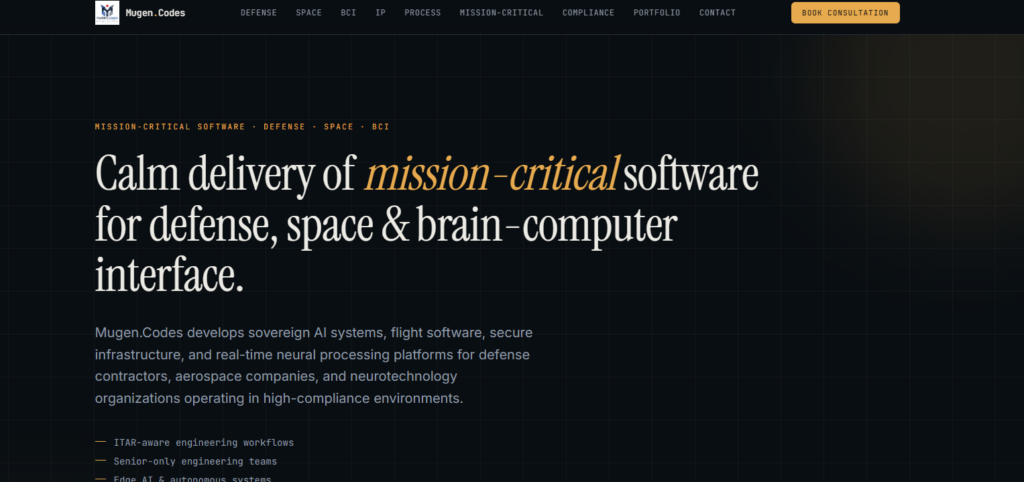
Mugen.Codes is a software engineering platform focused on building complex software systems. Its engineering approach is relevant to emerging technologies such as BCI, where software needs to integrate multiple components and operate reliably.
Engineering for Complex Technical Environments
Mugen.Codes approaches complex software projects through structured engineering and system-level thinking. This can help teams manage demanding technical requirements, integrations, and evolving system needs.
Secure and Reliable Software Architecture
Software architecture provides the foundation for a dependable system. Mugen.Codes focuses on architectures that support:
- Reliability
- Security
- Maintainability
- Scalability
Systems Integration and Interoperability
Complex systems often involve multiple software and hardware components. Mugen.Codes supports systems integration by considering how different components, interfaces, APIs, and data flows work together.
Testing, Verification, and Documentation
Testing and documentation are important for understanding whether software meets its requirements. Mugen.Codes applies structured engineering practices to support testing, verification, and clear technical documentation.
Mission-Critical and Emerging Systems
BCI software is part of a wider group of emerging technologies that can involve complex technical and operational requirements. Mugen.Codes brings software engineering principles such as reliability, integration, security, and verification to technically demanding systems.
FAQs
BCI software processes brain signals and converts relevant patterns into commands, data, or interactions with computers and connected devices.
It typically captures neural signals, processes the data, extracts useful features, decodes signal patterns, and converts the results into an output or command.
Python, C, C++, and MATLAB are commonly used across different parts of BCI development, depending on the system’s requirements.
Key challenges include neural signal variability, real-time processing, machine learning reliability, hardware integration, security, and system validation.
BCI hardware captures or interacts with neural signals, while BCI software processes and interprets those signals and connects the results to applications or devices.
Final Thoughts on BCI Software Development
BCI software provides the computational layer that turns complex neural signals into usable digital outputs. Building it requires more than signal processing alone. Developers need to consider architecture, machine learning, real-time performance, integration, security, testing, and long-term maintainability.
As BCI technology continues to develop, strong software engineering will remain important for turning complex technical concepts into dependable systems. Mugen.Codes brings a structured approach to complex software engineering, with capabilities spanning architecture, integration, testing, and reliable system development.
Exploring a complex software project involving emerging technology?
Explore Mugen.Codes to learn more about its software engineering capabilities and approach to building sophisticated, reliable software systems.